GRC & compliance automation
Compliance that maps itself.
Lavawall® reads your real posture and maps it to over 160 frameworks at once, generates the policies auditors expect, and collects evidence continuously, so "the auditor is asking" turns into a live compliance score instead of a lost weekend.
Start with the GRC WizardUnder a deadline?
Over 160 frameworks · generated policies · continuous evidence · PCI ASV
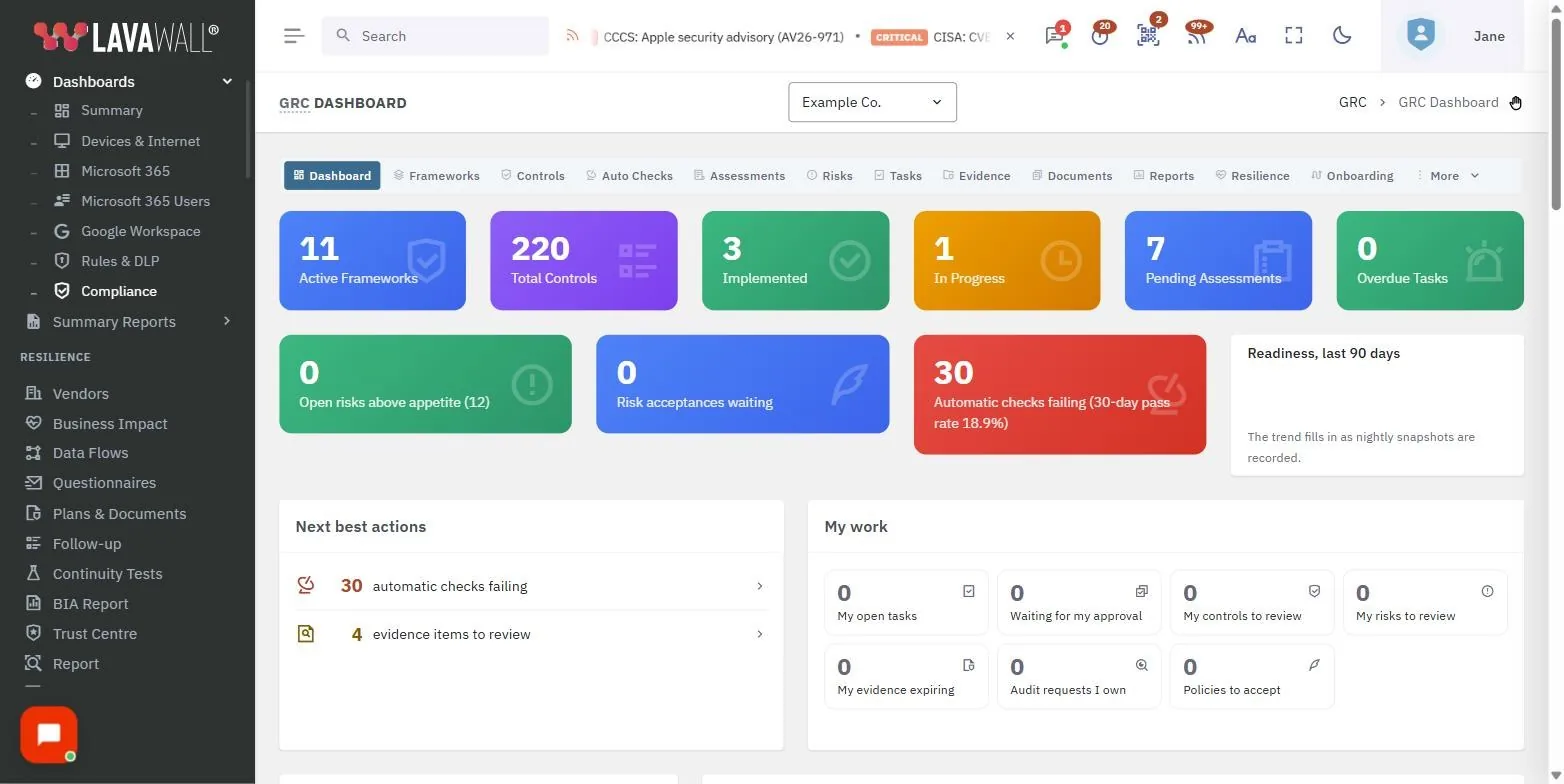
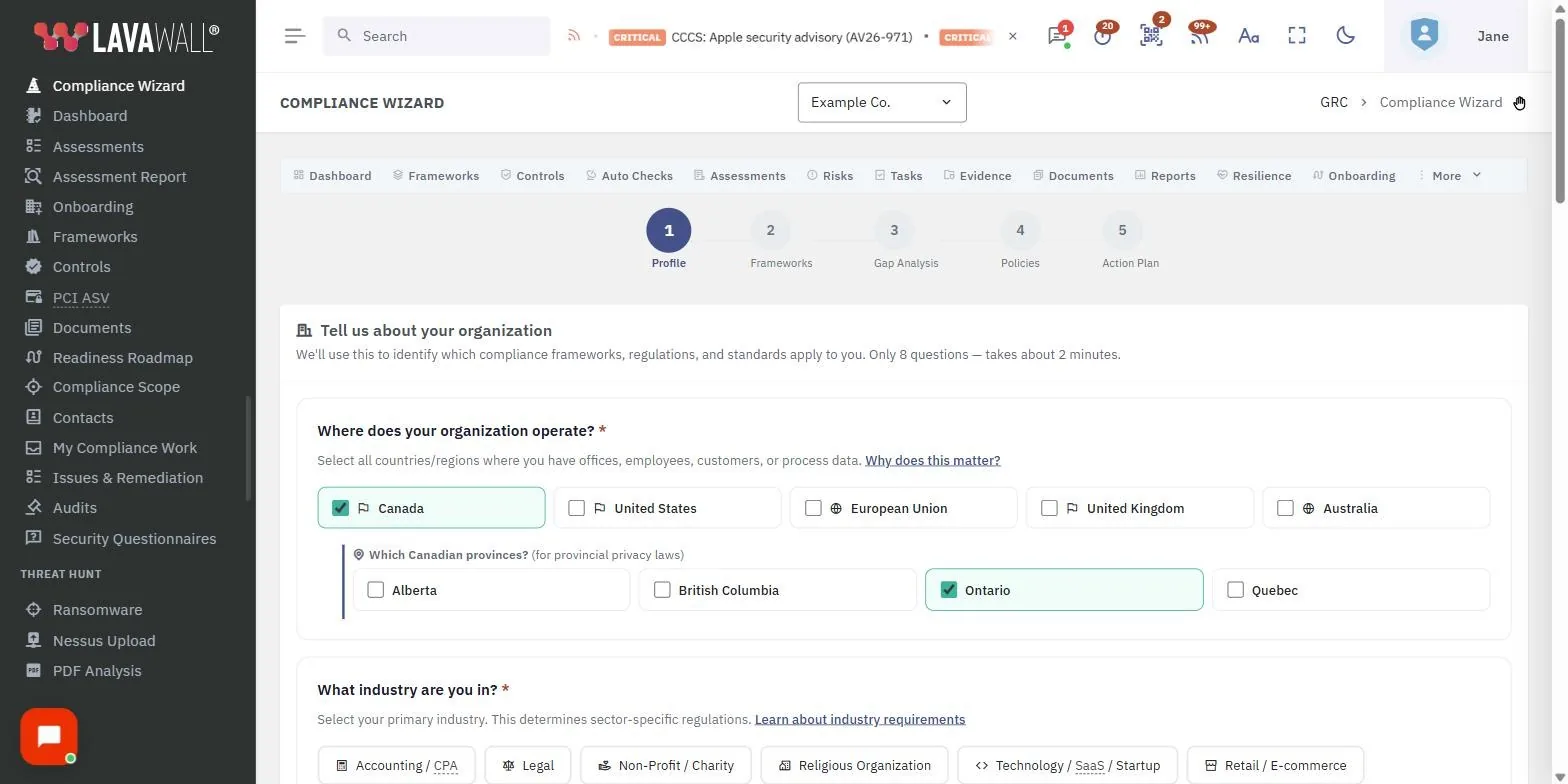
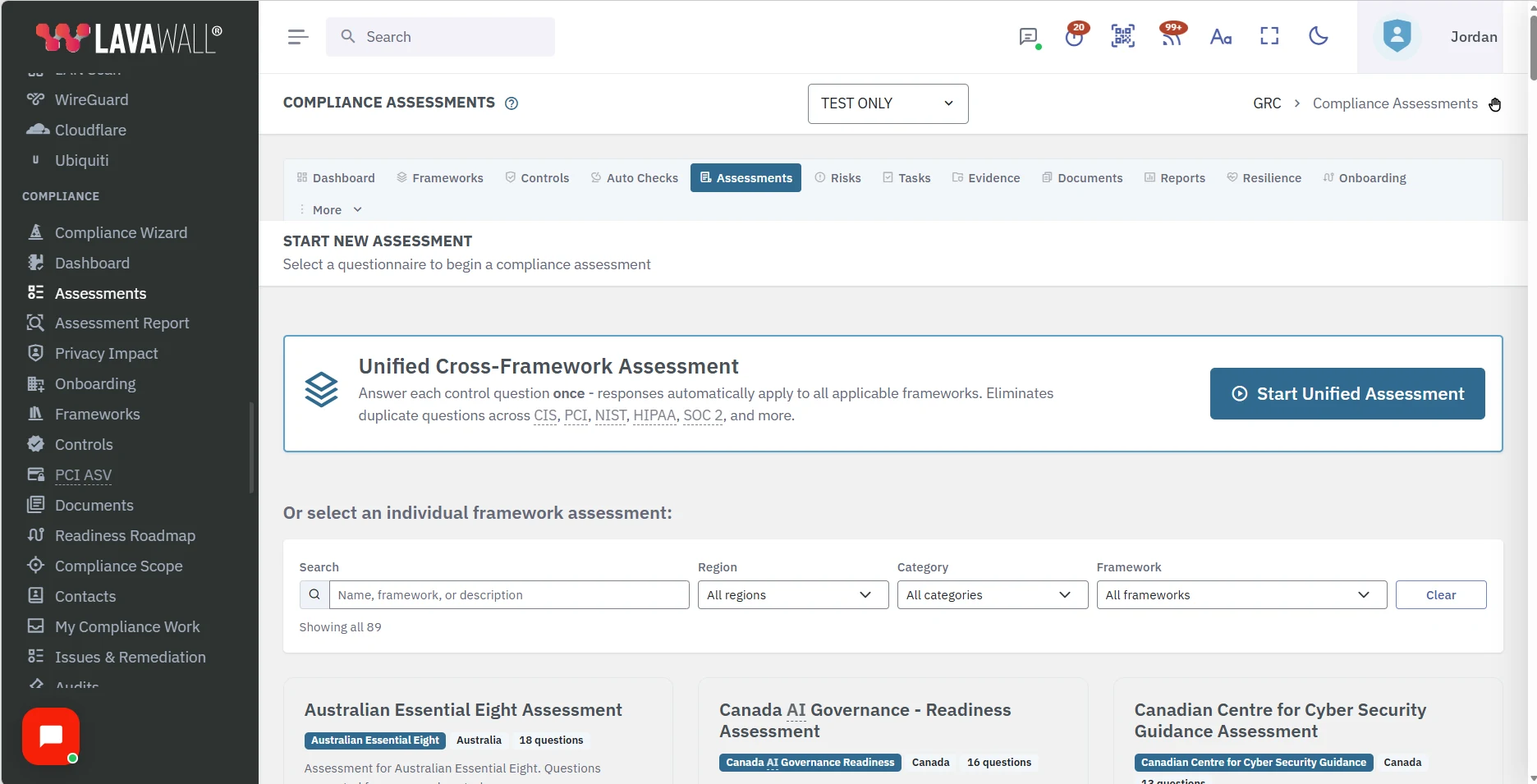
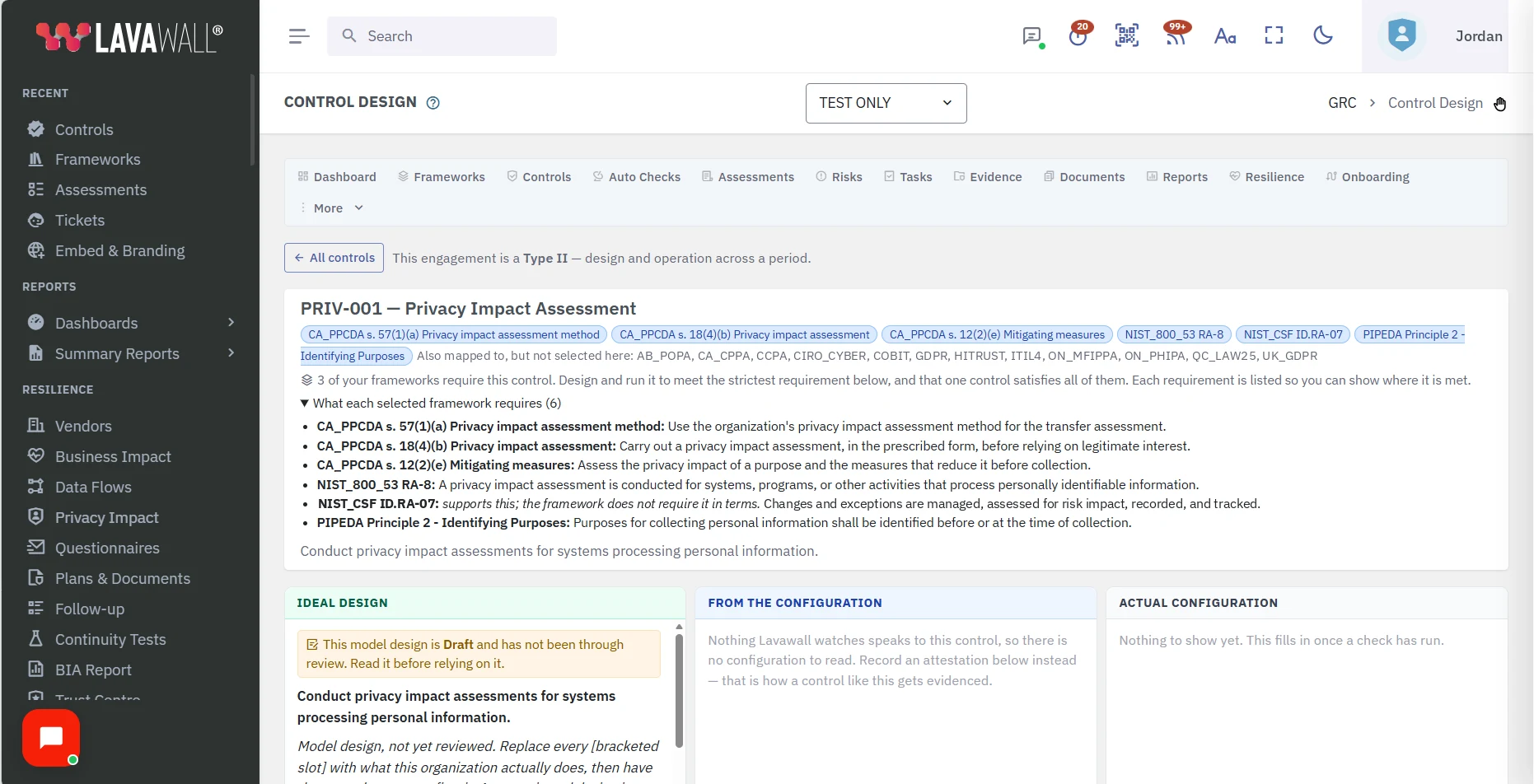
See it in the Lavawall® console
Real screens, shown with example data.
Does this sound like you?
Most organizations don't have one compliance obligation. They have a combination: a control framework or two, one or more privacy laws, and the rules for what they do. Here are a few, and yours will look different. That is the point, because almost nobody has just one.
A 12-person health-tech startup in BC
BC PIPA and PIPEDA for privacy; the BC E-Health Act if it touches a health information bank; PCI DSS for card payments; SOC 2 the moment a health authority asks; two breach clocks.
Six instruments, before twenty staff.
A Calgary accounting firm
Alberta PIPA and PIPEDA for client information; the CPA Canada cybersecurity expectations; FINTRAC when it handles client funds; SOC 2 if it runs any client-facing technology.
Five instruments.
A city of 40,000 in Iowa
The FBI CJIS Security Policy for policing; HIPAA once fire and EMS bill electronically; PCI DSS for utility and parking payments; AWIA for the water system; Iowa chapters 22, 21, and 715C; ADA Title II.
Eight instruments.
An Ontario medical-device company
PIPEDA, Ontario PHIPA, and HIPAA for privacy; FDA section 524B, Health Canada's guidance, and the lifecycle standards for device cybersecurity; SOC 2 or ISO 27001 for hospital IT.
Seven instruments (its quality system is a separate program).
A regulated investment broker in BC
BCFSA, CIRO cyber expectations, and CSA Staff Notice 33-322 from the sector regulators; FINTRAC for financial crime; BC PIPA and PIPEDA for privacy; SOC 2 if it runs client-facing technology.
Seven instruments.
A US SaaS company chasing enterprise deals
SOC 2 and often ISO 27001 for the sales cycle; CCPA and the growing list of US state privacy laws; the HIPAA Security Rule if a customer is in health care; PCI DSS if it takes payments.
Four to six instruments, climbing with each new state.
A US healthcare clinic
The HIPAA Security Rule and HITECH for patient data; state breach-notification laws; PCI DSS for co-pays and billing; and a business-associate agreement with every vendor that touches PHI.
Five instruments.
An MSP with forty clients
Every one of the above, times a book of business: a city, a clinic, a broker, and a manufacturer, each with a different obligation set, run from one console with per-tenant isolation and billing.
One platform, multi-tenant.
Not on this list? If you keep more than one framework, privacy law, or industry rule, whether you are an MSP running forty of these at once or a single business holding your own, you are exactly who Lavawall® is for. The question is never how big you are; it is how many obligations you carry.
From posture to proof
Map once, satisfy many
One control you turn on typically satisfies requirements across SOC 2, CIS, NIST, HIPAA, and more at the same time. Compliance Wizard, assessments, and onboarding guide the way.
Policies & documents, generated
Policies, procedures, and a system description are generated and kept current, not copied from a stale template you'll have to defend.
Continuous, timestamped evidence
Patch logs, MFA status, access reviews, encryption state, and backup records are captured automatically, plus integrated PCI ASV scanning.
A live score and gap list
See exactly which controls are open and how to close them, prioritized, per framework, across every tenant.
SOC 2 note: a SOC 2 report is issued only by a licensed CPA firm. Lavawall/ThreeShield gets you audit-ready and works alongside your CPA auditor.

The frameworks you need
When a client's questionnaire names a framework, it's already mapped.
A prospect asks for your SOC 2. An insurer wants CMMC 2.0. A hospital needs HIPAA and your Alberta clinic needs the AB HIA. Instead of starting each one from a blank page, Lavawall® maps your real posture to every framework at once, so the control you already turned on counts everywhere it applies.
Frameworks, standards, and regulations Lavawall® maps and evidences include:
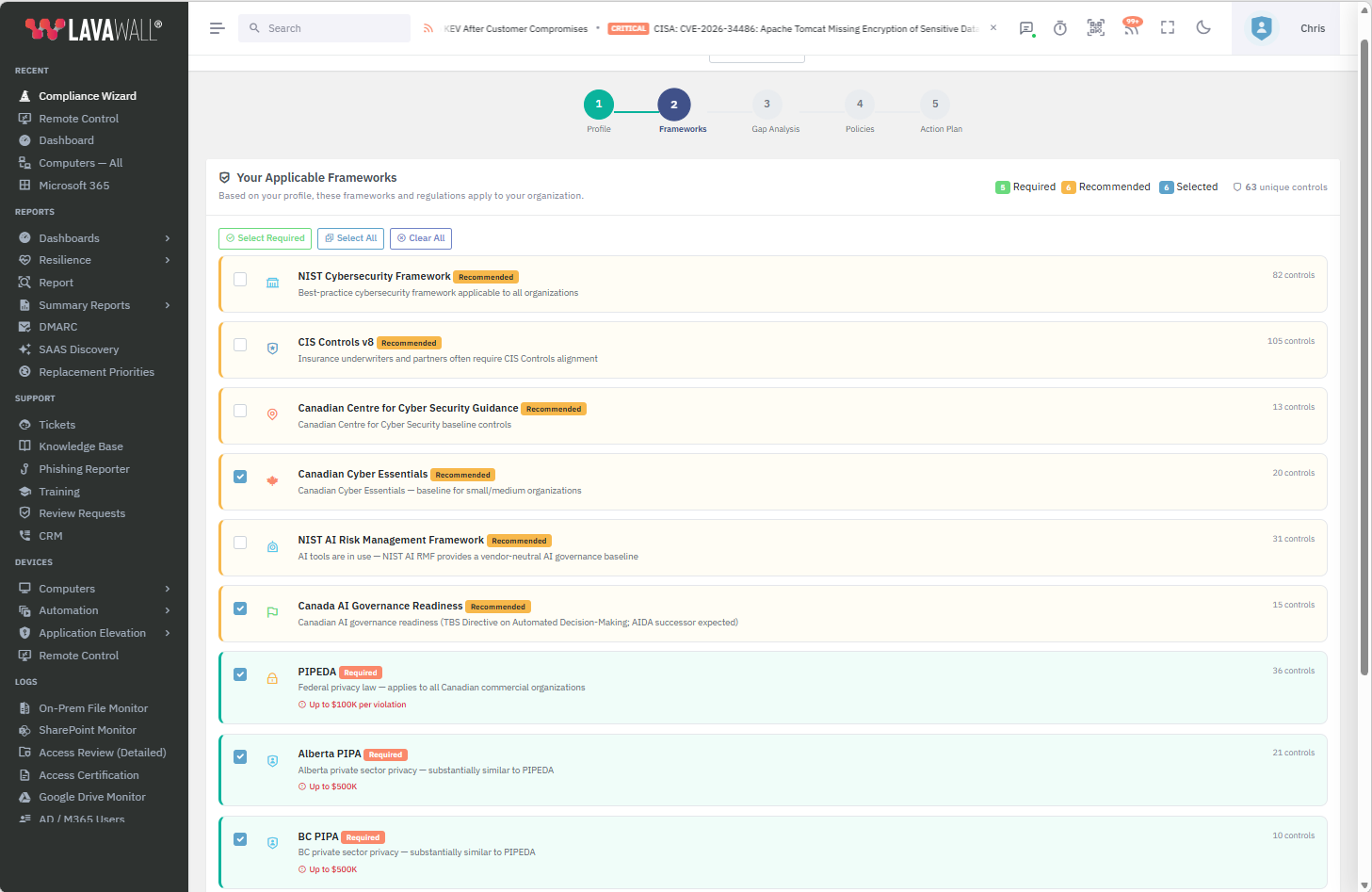
Security & governance
- CIS Controls v8 8.1
- Canadian Program for Cyber Security Certification (CPCSC) ITSP.10.171 Oct 2025; Level 1 Apr 2026
- NIST Cybersecurity Framework (NIST CSF) 2.0
- NIST SP 800-171 r3
- Canadian Centre for Cyber Security Guidance 2024
- COBIT 2019 2019
- ITIL 4 4
- Ontario Cyber Security Framework 2024
- ISO/IEC 27001 2022
- Sarbanes-Oxley Act (SOX) 2002
- C-SOX (Canadian Securities NI 52-109) 2023
- EU NIS2 Directive 2024
- CMMC v2.0
- UK Cyber Essentials 2025
- EU Cyber Resilience Act (CRA) 2024
- SOC 2 2024
- Canadian Cyber Essentials 2024
- Australian Essential Eight 2024
- Nova Scotia Personal Health Information Act (PHIA) S.N.S. 2010, c. 41; N.S. Reg. 217/2012
- Nova Scotia public sector privacy (FOIPOP, PIIDPA and the 2027 Act) 1993 Act, PIIDPA; 2025 c. 13 from 1 Apr 2027
- New York State privacy and security rules (sector tiers) Sources read 23 Oct 2026; see description
- New York SHIELD Act (GBL ss. 899-aa and 899-bb) GBL 899-aa (2025-03-28); 899-bb (2020-03-27)
- New Jersey state privacy and security law, by sector Statutes to P.L.2026, c.25; DOBI to Oct 2026
- New Jersey Data Privacy Act (NJDPA) P.L.2023, c.266 as amended to 30 June 2026
- Illinois state privacy and security law (sector tiers) Illinois law as read 23 Oct 2026
- Illinois Biometric Information Privacy Act (BIPA) 740 ILCS 14; P.A. 103-769 (eff. 2 Aug 2024)
- California state privacy and sector law (CalOPPA, breach, CMIA, DMV) Read 23 Oct 2026; see source list
- CPPA regulations: cybersecurity audits, risk assessments, ADMT 11 CCR Div. 6 Ch. 1, eff. 1 Jan 2026
- Texas state requirements by sector (privacy, health, public) Statutes read 23 Oct 2026
- Texas Data Privacy and Security Act (TDPSA) B&C Code ch. 541, in force 1 July 2024
- Texas Responsible Artificial Intelligence Governance Act (TRAIGA) B&C Code ch. 551-554, 1 Jan 2026
- Canada: Treasury Board Directive on Automated Decision-Making and AI guidance Directive amended 24 Jun 2025; Guide modified 24 Sep 2026
- Ontario public sector AI rules (EDSTA and the OPS AI Directive) EDSTA Sch. 1 ss. 1 to 16 in force 29 Jan 2025; Directive 1 Dec 2024
- Canadian provincial AI, deepfake and intimate image rules (tiers by province) Read 24 Oct 2026; several items not in force (see description)
- OSFI Guideline E-23: Model Risk Management (including AI and machine learning) OSFI page dated 11 Sep 2025; effective 1 May 2027
- Safe Social Media Act (Digital Safety Act) - Draft, Bill C-34, not in force Bill C-34, first reading 10 June 2026; second reading in the House (debate 21 Oct 2026)
- TAKE IT DOWN Act (Pub. L. 119-12), platform notice and removal Pub. L. 119-12, 19 May 2025; section 3 duties from 19 May 2026
- US state minors online safety laws (design codes, social media, app stores) State laws and court status read 24 Oct 2026; see description
- Family Educational Rights and Privacy Act (FERPA), 34 CFR Part 99 34 CFR Part 99, eCFR read 24 Oct 2026
- Children's Internet Protection Act (CIPA), E-rate certifications 47 U.S.C. 254(h), (l); 47 CFR 54.520, eCFR read 24 Oct 2026
- Accessible Canada Act and Regulations (federally regulated entities) Act and regs current to 30 Sep 2026
- Manitoba Accessibility for Manitobans Act and standards C.C.S.M. c. A1.7, current 22 Oct 2026
- Nova Scotia Accessibility Act and Built Environment Standard S.N.S. 2017, c. 2; standard from 1 Apr 2026
- Accessible British Columbia Act and Regulation S.B.C. 2021, c. 19; B.C. Reg. 105/2022
- Saskatchewan Accessible Saskatchewan Act and Regulations In force 3 Dec 2023; reports read 24 Oct 2026
- Newfoundland and Labrador Accessibility Act SNL 2021 c A-1.001; in force 3 Dec 2021
- Quebec Act to secure handicapped persons (annual accessibility action plans) CQLR c. E-20.1; Office guidance read 24 Oct 2026
- Colorado Automated Decision-Making Technology Act (SB 26-189, replacing SB 24-205) SB 26-189 signed 14 May 2026; effective 1 Jan 2027
- US state artificial intelligence laws (frontier, transparency, chatbots, employment, health care, government) Status as of 23 Oct 2026; see description
- Alabama Personal Data Protection Act (PDPA) HB 351 (2026 Reg. Sess.), enrolled; effective 1 May 2027 (not yet in force)
- Colorado Privacy Act (CPA) C.R.S. 6-1-1301 to 6-1-1314; in force 1 July 2023
- Connecticut Data Privacy Act (CTDPA) Conn. Gen. Stat. 42-515 et seq.; in force 1 July 2023; 2025 changes from 1 July 2026
- Delaware Personal Data Privacy Act (DPDPA) 6 Del. C. ch. 12D; in force 1 Jan 2025; amended text from 1 Jan 2027
- Florida Digital Bill of Rights (FDBR) Fla. Stat. 501.701 to 501.722; in force 1 July 2024
- Iowa Consumer Data Protection Act (ICDPA) Iowa Code ch. 715D; in force 1 Jan 2025 (2023 Acts ch. 17)
- Indiana Consumer Data Protection Act (ICDPA) IC 24-15; in force 1 Jan 2026 (P.L.94-2023)
- Kentucky Consumer Data Protection Act (KCDPA) KRS 367.3611 to 367.3629; in force 1 Jan 2026 (2024 Ky. Acts ch. 72)
- Louisiana Data Privacy Act (LDPA) La. R.S. 51:1780.1 to 1780.5 (Act 502 of 2026, SB 386); effective 1 Jan 2027 (not yet in force)
- Manitoba Personal Health Information Act (PHIA) C.C.S.M. c. P33.5; M.R. 245/97
- Manitoba Freedom of Information and Protection of Privacy Act (FIPPA) C.C.S.M. c. F175; M.R. 64/98
- Saskatchewan Health Information Protection Act (HIPA) S.S. 1999, c. H-0.021; H-0.021 Reg 2 (2023)
- Saskatchewan public sector privacy (FOIP and LA FOIP) S.S. 1990-91, c. F-22.01 and c. L-27.1
- New Brunswick Personal Health Information Privacy and Access Act (PHIPAA) S.N.B. 2009, c. P-7.05; N.B. Reg. 2010-112
- New Brunswick Right to Information and Protection of Privacy Act (RTIPPA) S.N.B. 2009, c. R-10.6; N.B. Reg. 2010-111
- Canada's Anti-Spam Legislation (CASL) S.C. 2010, c. 23, current to 2026-09-30
- Canada National Do Not Call List and Telemarketing Rules (CRTC) Telecommunications Act ss. 41 to 41.7, current to 2026-09-30; CRTC Rules compilation modified 2014-03-31
- CAN-SPAM Act and FTC CAN-SPAM Rule 15 U.S.C. 7701 to 7713; 16 CFR Part 316 (eCFR 2026-10-20)
- Telephone Consumer Protection Act (TCPA) and FCC Rules 47 U.S.C. 227; 47 CFR 64.1200 (eCFR 2026-10-20); FCC 26-67 effective 2026-11-25
- Maryland Online Data Privacy Act of 2024 (MODPA) Comm. Law 14-4601 to 14-4614 (Ch. 455, 2024)
- Minnesota Consumer Data Privacy Act (MCDPA) Minn. Stat. 325M.10 to 325M.21 (2024)
- Montana Consumer Data Privacy Act (MCDPA) MCA 30-14-2801 to 2820 (2023, amended 2025)
- Nebraska Data Privacy Act (NDPA) LB 1074 (2024), ss. 1 to 30
- New Hampshire Expectation of Privacy Act (RSA 507-H) RSA 507-H:1 to 507-H:12 (SB 255, 2024)
- Oklahoma Consumer Data Privacy Act (OCDPA) Enrolled SB 546 (2026); effective 1 Jan 2027
- Oregon Consumer Privacy Act (OCPA) ORS 646A.570 to 646A.589 (as amended 2025)
- Rhode Island Data Transparency and Privacy Protection Act R.I. Gen. Laws 6-48.1-1 to 6-48.1-10 (2024)
- Tennessee Information Protection Act (TIPA) T.C.A. 47-18-3201 to 3213 (Pub. Ch. 408)
- Utah Consumer Privacy Act (UCPA) Utah Code 13-61-101 to 13-61-404 (2022)
- Vermont Data Privacy and Online Surveillance Act (VTDPOSA) Act 145 (2026); effective 1 Jan 2028
- Virginia Consumer Data Protection Act (VCDPA) Va. Code 59.1-575 to 59.1-584 (to 2026)
- NAIC Insurance Data Security Model Law (#668), state adoptions Model #668; state laws as read 24 Oct 2026
- Consumer health data laws: Washington, Nevada and Connecticut RCW 19.373 (2023 c 191); NRS 603A.400-.550; CT AG page
- Biometric privacy laws beyond Illinois and Texas RCW 19.375; C.R.S. 6-1-1314 (HB 24-1130); local ordinances
- US state data breach notification: common elements and state differences State statutes and AG pages read 24 Oct 2026
- Newfoundland and Labrador Personal Health Information Act (PHIA) SNL 2008, c P-7.01 (in force 1 Apr 2011)
- Newfoundland and Labrador Access to Information and Protection of Privacy Act, 2015 (ATIPPA) SNL 2015, c A-1.2 (amended to 2026 c16 s2)
- Prince Edward Island Health Information Act (HIA) RSPEI c H-1.41 (unofficial consolidation read)
- Prince Edward Island Freedom of Information and Protection of Privacy Act (FOIPP) RSPEI 1988, c F-15.01 (unofficial consolidation read)
- Quebec Act respecting health and social services information (S.Q. 2023, c. 5) SQ 2023, c 5 (main parts in force 1 Jul 2024)
- Quebec Access Act, public sector (as modernized by Law 25) CQLR c A-2.1, as amended by SQ 2021, c 25
- Yukon Health Information Privacy and Management Act (HIPMA) SY 2013, c 16 (statute text not read)
- Yukon Access to Information and Protection of Privacy Act (ATIPP Act) SY 2018, c 9 (statute text not read)
- Northwest Territories Health Information Act (HIA) SNWT 2014, c 2 (in force 1 Oct 2015)
- Northwest Territories Access to Information and Protection of Privacy Act (ATIPPA) SNWT 1994, c 20; amended SNWT 2019, c 8 (in force 30 Jul 2021)
- Nunavut Access to Information and Protection of Privacy Act (ATIPPA) SNWT 1994, c 20 as duplicated for Nunavut (2012 office consolidation)
- Canada Privacy Act (federal institutions) RSC 1985, c P-21 (current to 30 Sep 2026; amended 2 Jun 2025)
- Pennsylvania privacy, security and AI (sector tiers) Sector rules read 23 Oct 2026
- Pennsylvania Breach of Personal Information Notification Act Act 94 of 2005, as amended 2022 and 2024
Privacy
- CCPA / CPRA 2023
- Alberta PIPA 2022
- BC PIPA 2023
- Quebec Law 25 (Private Sector Privacy) 2024
- BC FIPPA 2023
- EU GDPR 2018
- UK GDPR / Data Protection Act 2018 2021
- Australian Privacy Act 1988 2024
- PIPEDA 2024
- Children's Online Privacy Protection Rule (COPPA) 16 CFR 312, amended 2025
- Consumer Privacy Protection Act (CPPA) - Draft, not in force Bill C-27 first reading (died 6 January 2025)
- Protecting Privacy and Consumer Data Act (PPCDA) - Draft, Bill C-36, not in force Bill C-36 first reading (15 June 2026)
Payment card
Energy & critical infrastructure
Government & public sector
- NIST SP 800-53 - Security and Privacy Controls Rev. 5
- FBI CJIS Security Policy 6.1
- FBI CJIS Security Policy 5.9.5 (Pre-Modernization) 5.9.5
- Alberta Protection of Privacy Act (POPA) / Access to Information Act (AITA) 2025
- Ontario MFIPPA - Municipal Freedom of Information and Protection of Privacy Act (as amended by Bill 194) 2024 amendments
- Iowa Public Sector Information Obligations 2026
- IRS Publication 1075 - Federal Tax Information 2024
- US Water & Wastewater Cyber Security (AWIA) 2026
- ADA Title II - Web and Mobile Accessibility 2024 Final Rule
- GovRAMP (formerly StateRAMP) - Cloud Vendor Assurance 2026
- CCCS Cloud Control Profiles (ITSP.50.103) ITSP.50.103 Annexes A and B
- CCCS Cloud Assessment: Medium and PBHVA Program page June 2026; ITSM.50.100
- CCCS Common Criteria Program (Product Certification) Program Instructions v2.3 (May 2025)
- Ontario AODA - Integrated Accessibility Standards (O. Reg. 191/11) O. Reg. 191/11, consolidated 30 March 2026
- WCAG 2.0 - Web Content Accessibility Guidelines 2.0 W3C Recommendation, 11 December 2008
- WCAG 2.2 - Web Content Accessibility Guidelines 2.2 W3C Recommendation, 12 December 2024 (first publis
- WCAG 3.0 Working Draft (10 September 2026) - DRAFT, not a standard W3C Working Draft, 10 September 2026 (draft)
Healthcare
- HITRUST CSF 11
- HIPAA Security Rule 2024
- BC E-Health Act 2024
- Alberta Health Information Act 2024
- FDA Cybersecurity for Cyber Devices (Section 524B) 2026 guidance
- Health Canada Medical Device Cybersecurity June 2019 guidance
- IEC 81001-5-1 Health Software Security Life Cycle 2021
- ANSI/AAMI SW96 Medical Device Security Risk Management 2023
- HSCC Medical Device and Health IT Joint Security Plan v2.0 (March 2024)
- Ontario Personal Health Information Protection Act (PHIPA) 2004, as amended
AI governance
- NIST AI Risk Management Framework 1.0 + GenAI Profile (NIST-AI-600-1)
- ISO/IEC 42001 - AI Management System (AIMS) 2023
- EU Artificial Intelligence Act - Readiness Reg. (EU) 2024/1689
- OWASP Top 10 for LLM Applications 2025
- Canada AI Governance Readiness 2026
- ISO/IEC 27090 - AI Security Threats and Compromises 2026
Financial services
- FTC Safeguards Rule 2023
- GLBA: Gramm-Leach-Bliley Act 2023
- NYDFS Cybersecurity Regulation 2023
- FINTRAC / PCMLTFA 2024
- EU DORA 2025
- BC Financial Services Authority Security Guidance 2024
- CPA Canada Cybersecurity Framework 2024
- CIRO Cybersecurity Program - Dealer Members 2026
- CSA Staff Notice 33-322 - Registered Firm Cybersecurity 15 July 2026
One turned-on control typically satisfies requirements across several of these at once. New frameworks are added regularly, and ThreeShield's CISSP/CISA team can scope any of them with you.
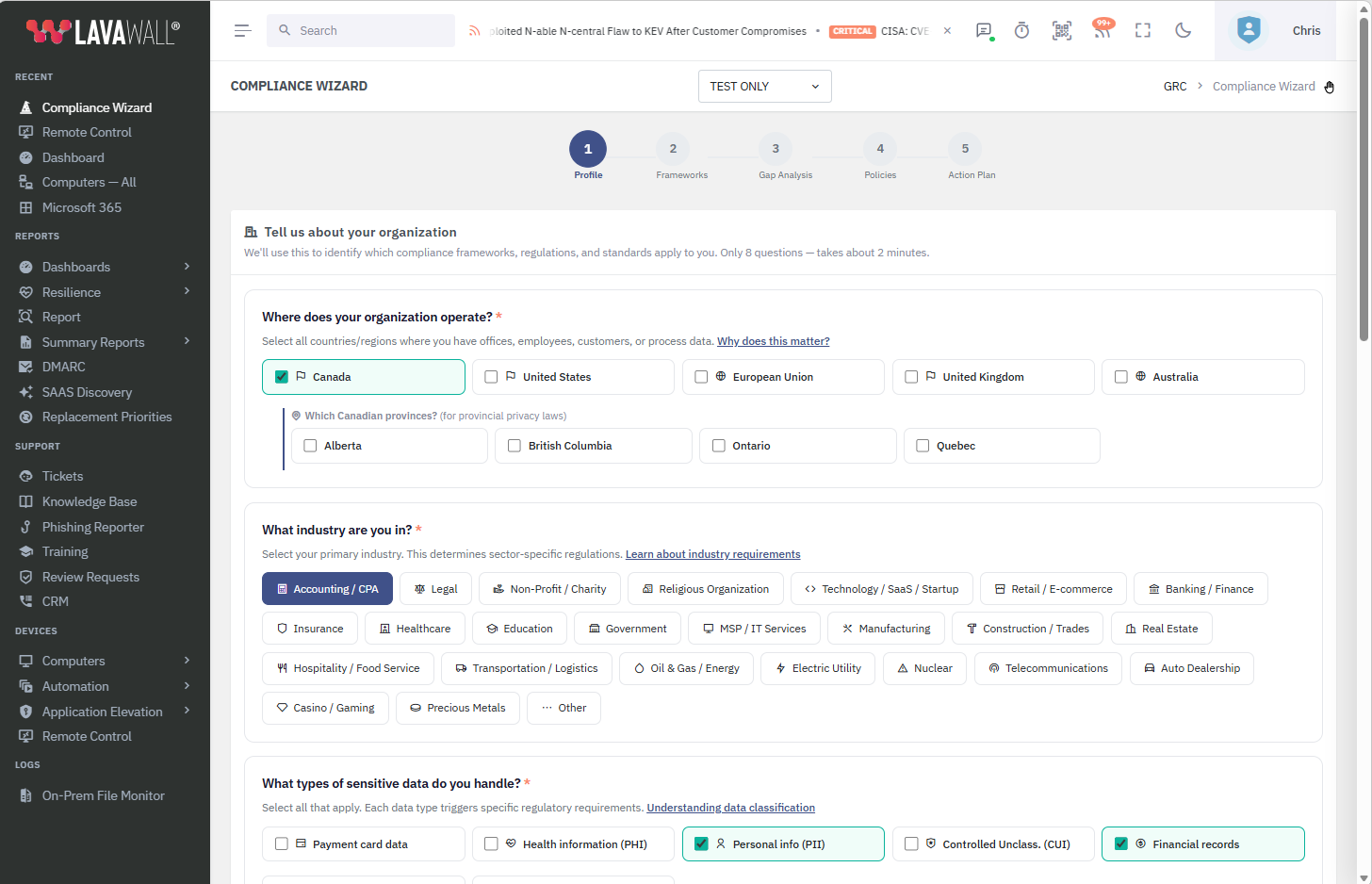
One wizard. Your whole compliance program.
The GRC Wizard asks about your business in plain language, takes your industry and compliance requirements into account, and does the heavy lifting for you.
Built from the data you already collect
The wizard reads the security and IT data Lavawall® already gathers about your environment, so you are not re-entering what the platform can already see.
Policies and action plans, generated
It auto-generates the policies auditors expect and the action plans that tell you what to do next, matched to your industry and the frameworks you need to meet.
Plain language, start to finish
No jargon and no blank templates. Answer a few questions and the wizard turns your requirements into a working compliance program you can hand to an insurer, a client, or an auditor.
The GRC & Resilience suite
The wizard builds on a full set of resilience tools, each one plain language, each one fed by the security and IT data you already collect.
Business Impact Assessment
Work out which systems and processes matter most, and what it costs you when they stop, in plain language.
Learn more →Vendor Inventory
Keep a living list of the vendors and tools you rely on, so you know who touches your data and where your risk sits.
Learn more →Continuity & incident plans
Generate the business-continuity and incident-response plans you need before something goes wrong, and keep them current.
Learn more →Stakeholder questionnaires
Send and track the security and privacy questionnaires clients, insurers, and partners ask you to fill in.
Learn more →Trust Centre
Give clients and prospects a single page that shows your security posture, so you answer the same questions once.
Learn more →AI governance
Set the guardrails and policies for how your team uses AI, and show that you have them in place.
Learn more →Industry policy packs
Ready-made privacy, acceptable-use, AI, and client-consent documents for your industry, in Canadian and US variants.
Learn more →Controls that test themselves
Most GRC tools hand you a list of controls and ask you to attest to each one by hand, over and over. Lavawall works the other way around. It reads the live configuration and the user issues it already sees across Microsoft 365, Google Workspace, macOS, Windows, Linux, and more, and fills in the matching controls for you. A misconfiguration or a risky user setting raises an alert and also updates the control it maps to.
The result is evidence that is collected from the system that runs the control, not typed into a questionnaire and hoped to be true. When the posture changes, the control changes with it, so what an auditor sees is what is actually in place today.
An incident response plan that knows every deadline
When something goes wrong, the hard part is often knowing who has to be told, and by when. Visa wants to hear within three calendar days, American Express within 72 hours, NYDFS within 72 hours of determining an incident occurred, a NIS2 entity within 24 hours, and a DORA financial entity within four hours of classifying an incident as major. Each clock starts from a different moment.
Lavawall's plan builder asks a few questions, then writes a plan with every reporting deadline and contact for the rules you follow: PCI DSS and the card brands, PIPEDA and the proposed PPCDA, Quebec Law 25, NIS2, DORA, the GDPR, the FTC Safeguards Rule, NYDFS, CIRO, the Canadian Securities Administrators, CJIS, NERC CIP-008, TSA pipeline directives, HIPAA, Iowa, IRS Publication 1075, and more. Each deadline is checked against the regulator's or card brand's own text and names its source.
When an incident happens, record it and the reporting clocks start counting down from the times you enter. Mark each report filed as you go, and keep a timeline that shows what was known and when. Tabletop exercise guides built from your plan help your team rehearse, and each exercise you record counts toward the yearly testing most of these rules require.
Bring your own auditor
An audit gets slow and expensive when the auditor works at arm's length, asking for screenshots and waiting on emailed evidence. Lavawall gives your external auditor a direct, controlled way in: they access the GRC, review the controls and the evidence behind them, evaluate your posture, and sign off, all inside the same system. Less back and forth, a shorter engagement, and a lower bill.
You are not locked to one firm, either. Bring the auditor you already trust, or have ThreeShield's CISSP- and CISA-credentialled team run the examination with you. See how Lavawall compares as a GRC audit tool.
The documents Lavawall writes for you
Lavawall® uses data you already have, led by your Business Impact Assessment, and writes each of these in plain language, auto-filled from your records rather than typed from a blank page.
- Incident Response Plan · who to tell and by when, with your contacts, acquirer and regulator deadlines, and playbooks for the services you use filled in for you, and live reporting clocks during an incident.
- Disaster Recovery Plan · recovery priorities, backup expectations, and restore order, auto-filled from your BIA recovery targets.
- Business Continuity Plan · the umbrella policy that keeps the business running and ties the other two plans together.
- Foreign Processing Disclosure · a Canadian outside-Canada privacy disclosure, built from the services that move your data across the border.
- Data Flow Documentation · what information moves between your systems and how, mapped from the apps Lavawall detects.
- Privacy Policy addendum · your service providers, AI use, and international processing, written into one addendum.
- Industry Privacy Policy packs · ready-made privacy documents matched to your industry, in Canadian and US variants.
Want the audit run with you?
ThreeShield, the CISSP/CISA team that builds Lavawall®, scopes the framework, operationalizes controls, and prepares you so the examination is fast and predictable.
Pricing, published
Almost nobody in this category publishes a number. Here is ours, beside how the rest of the category answers the question.
Lavawall® Complete
$89.50 /seat/year
Annual, two months free. A seat is the greater of your managed devices or your Microsoft 365 / Google Workspace licensed users, never both.
Starts at $2,237.50/year for the first 25 seats, and every compliance framework in the catalogue is included, along with the business-continuity module, your policies, and a Trust Centre.
No per-framework fee: the whole catalogue is in Complete. Volume discounts start at 51 seats.
The rest of the category
Quote only / book a call
Most GRC platforms publish no public price; you request a quote to find out. Lavawall lists its number here and on the pricing page.
A published number is the first thing a buyer can check.
Volume discount, by seat
| 1–50 seats | list price |
| 51–250 seats | 5% off |
| 251–1,000 seats | 10% off |
| 1,001–5,000 seats | 15% off |
| 5,001+ seats | 20% off |
A few scenarios
| Organization | Assumptions | Lavawall / year |
|---|---|---|
| 20-person BC health-tech | 25 seats (the minimum), every framework it needs included | $2,237.50 |
| 50-person services firm | 50 seats, every framework included | $4,475 |
| 250-seat organization | 250 seats at the 5% volume tier, every framework included | $21,256.25 |
Lavawall®’s number is on this page and on the pricing page; most of the category makes you ask for it.
For most of these buyers, though, the real alternative to Lavawall is not another compliance platform at all. It is a consultant at $15,000 to $40,000 and a spreadsheet, repeated every year, with nothing left behind between engagements. See the full pricing page for the calculator.
Common questions
- Who is Lavawall GRC for?
- Any organization whose compliance is a combination rather than a single framework: a health-tech startup, an accounting firm, a municipality, a medical-device manufacturer, an investment broker, or an MSP running all of these for its clients. The common thread is carrying more than one framework, privacy law, or industry rule at once.
- Is Lavawall only for MSPs?
- No. Lavawall is multi-tenant, so an MSP can run a whole book of clients from one console, and it works the same way for a single organization holding several obligations of its own.
- Which frameworks are supported?
- Over 160, including CIS v8.1, NIST CSF 2.0, NIST 800-171, SOC 2, HIPAA, PCI DSS (all SAQs), ISO 27001:2022, CMMC 2.0, Canada's CPCSC, PIPEDA, Alberta/BC health & privacy acts, Quebec Law 25, CPA Canada, OSFI, IIROC/CIRO, EU GDPR/NIS2/DORA, UK Cyber Essentials, and Australia's Essential Eight.
- Can Lavawall issue our SOC 2 report?
- No. Only a licensed CPA firm can. Lavawall gets you audit-ready and works alongside your auditor.
- Do you include PCI ASV scanning?
- Yes. Lavawall integrates Clone Systems PCI ASV scanning, with missed-scan notifications and report inclusion.