Continuity & incident plans
The plans auditors ask for, written around your actual tools.
Lavawall® builds the continuity and incident plans auditors and cyber insurers ask for, two ways at once: generated from the security and IT data you already have, and filled in through short plain-language interviews anyone can complete. Answer once, and you get a full set of plans with specific “what to do if this goes down” guidance, instead of a stale template you'd have to defend.
Start with the GRC Wizard See the GRC engine
Generated from your connected tools · plain-language interviews · no stakeholder login · audit- and insurer-ready
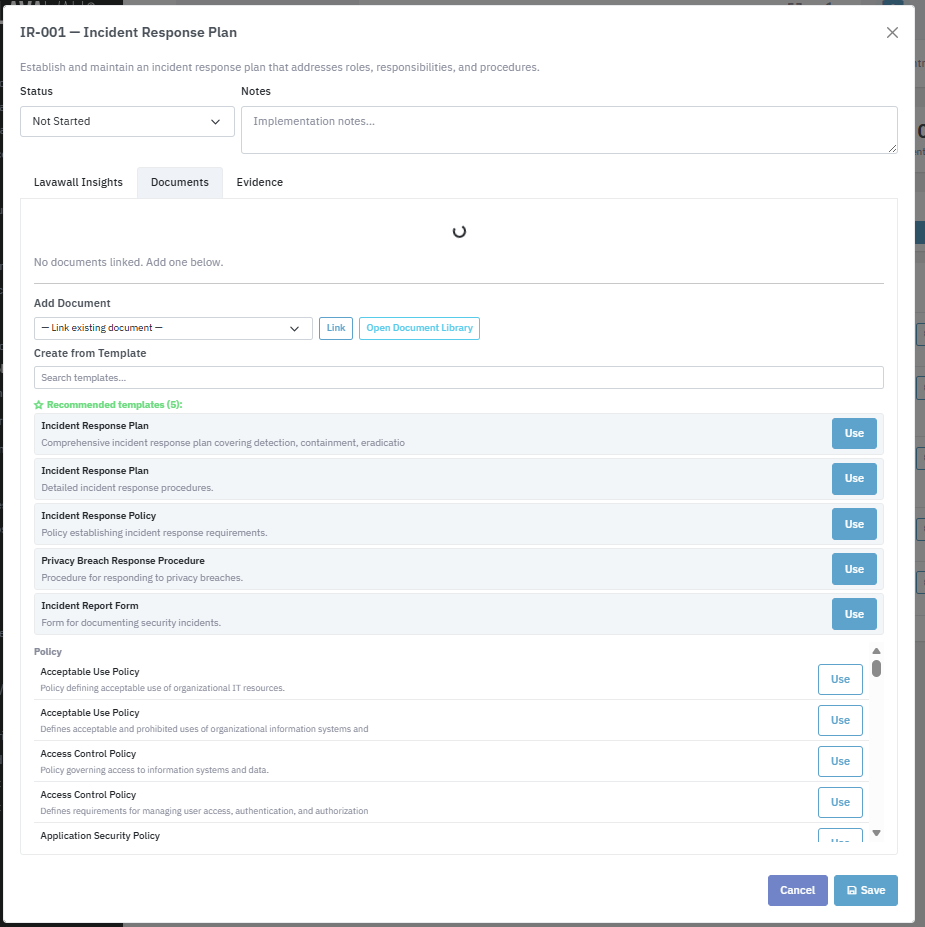
See it in the Lavawall® console
Real screens, shown with example data.
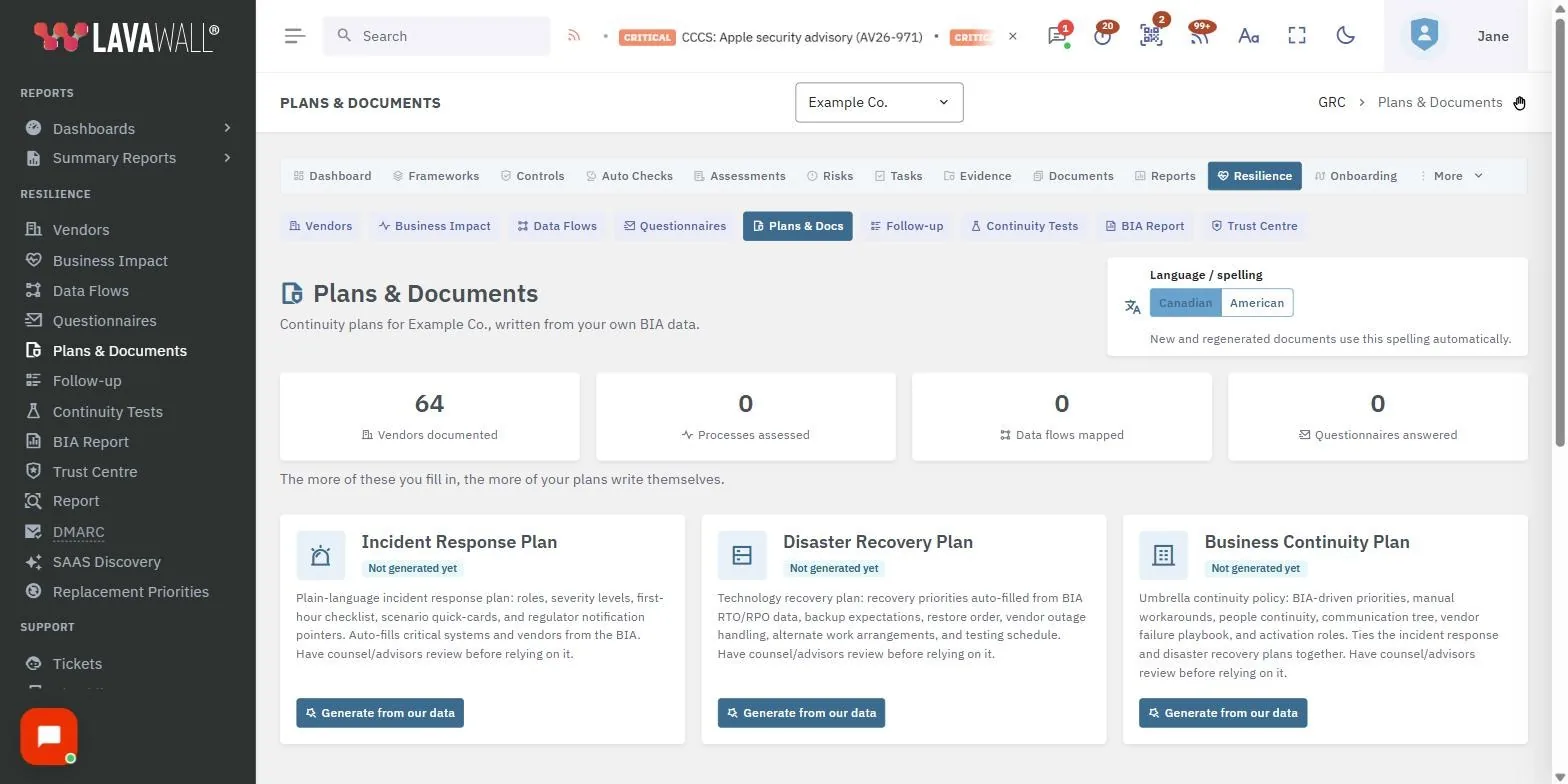
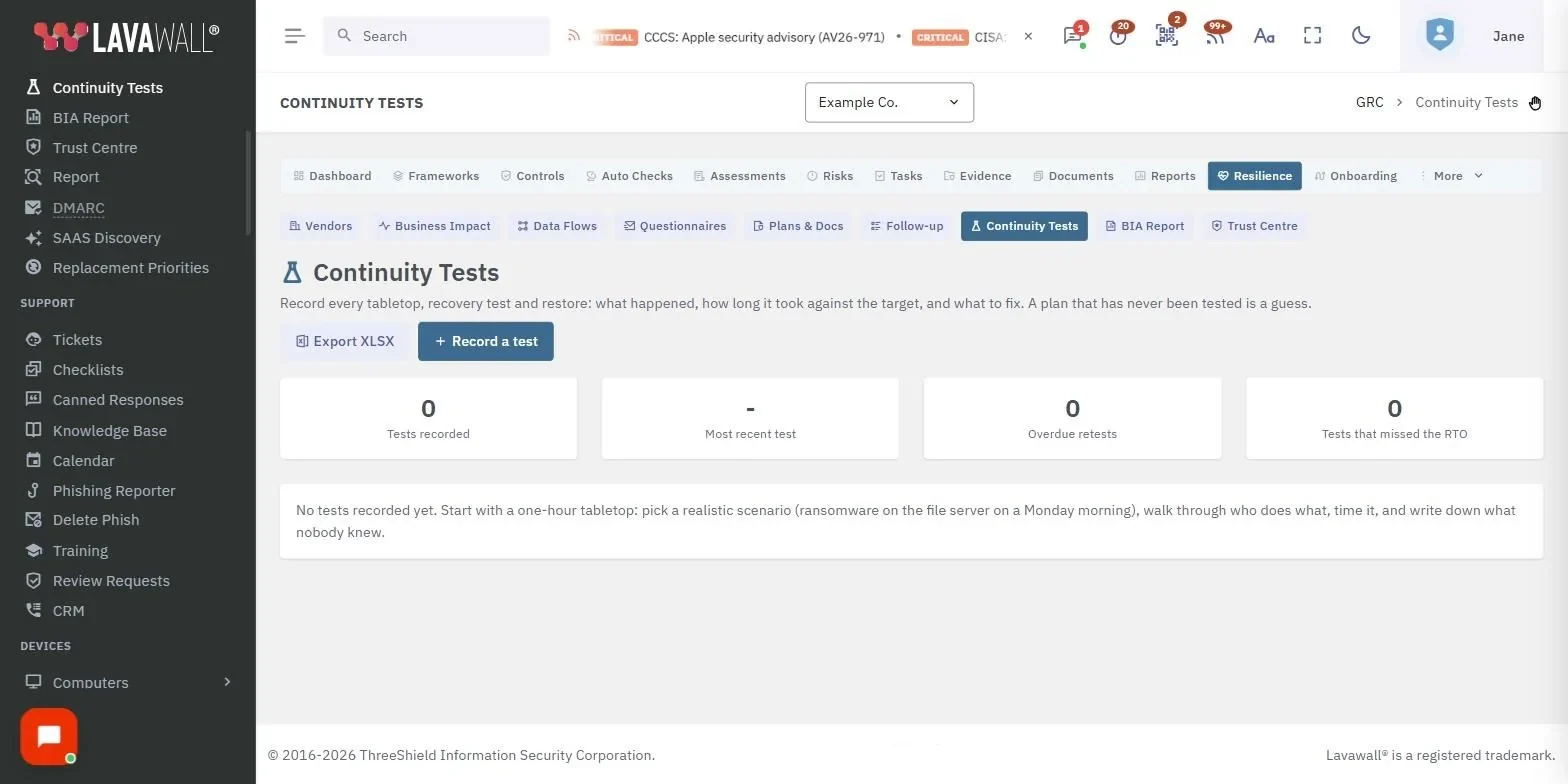
Two ways in, one set of documents
Generated from data you already have
Lavawall reads the security and IT posture already connected to your account (the apps it detects, your backups, your identity and endpoint controls) and drafts the technical backbone of every plan for you. No blank page, no guessing which systems to list.
Interviews anyone can finish
The parts only people know (who owns what, which processes are critical, and how the business keeps running) come from short, plain-language questionnaires. No login is required for stakeholders, and everything works on a phone, so busy people actually complete them.
Specific, not generic
Because the documents are built from your real tools and answers, they carry concrete “what to do if X goes down” guidance instead of template filler you'd have to explain in an audit.
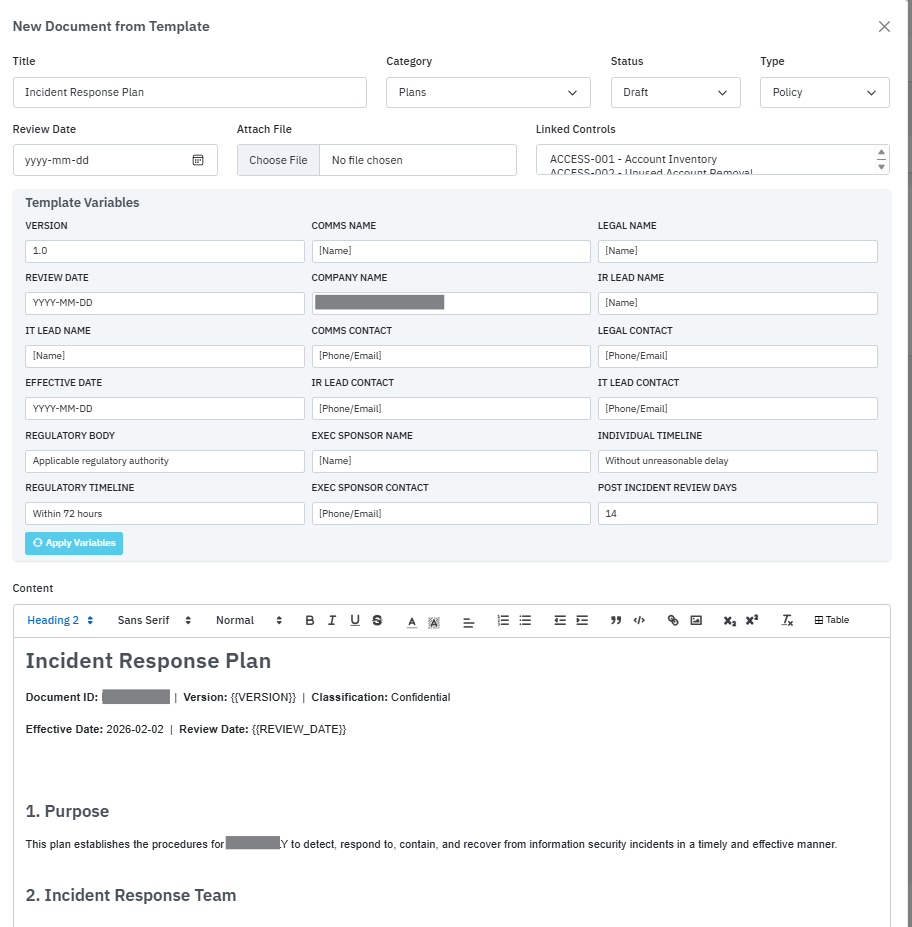
The documents you get
Answer the interviews once and Lavawall generates the documents auditors and insurers ask for, each written around your actual tools and processes.
Incident Response Plan
A plan wizard that fills itself in: your team and contacts, your card acquirer's published incident line, and every regulator and card brand deadline for where you operate and the frameworks you follow. Breach playbooks for the services Lavawall finds you using are added for you, alongside roles, severity levels, and a first-hour checklist. During an incident each deadline runs as a live clock, and reviewers without a Lavawall account can approve the plan through a private link.
Learn more →Disaster Recovery Plan
Your technology recovery plan, with recovery priorities auto-filled from the RTO and RPO targets in your BIA. It sets backup expectations and restore order, covers how to handle a vendor outage and where people work when systems are down, and includes a testing schedule so recovery is rehearsed before you need it.
Business Continuity Plan
The umbrella continuity policy that ties the incident response and disaster recovery plans together. BIA-driven priorities, manual workarounds, people continuity, a communication tree, a vendor-failure playbook, and the roles that activate it are all set out in one place.
Data Flow Documentation
What information moves between your systems and how, mapped from the apps Lavawall detects so the picture matches reality.
Learn more →Foreign Processing Disclosure
Where your data leaves the country and through which services, paired with the correct privacy-law notices for the jurisdictions you operate in.
Learn more →Privacy Policy addendum
Ties your vendors, service providers, AI use, and international processing together into one addendum that stays consistent with the rest of your plans.
Learn more →A word of caution: these are starting drafts, generated from your records so you are not staring at a blank page. Have counsel or your advisors review them before you rely on them.
Ready-made playbooks for the incidents that actually happen
Ransomware
Contain, preserve evidence, and restore from your backups in the right order, with the decision points laid out before the pressure hits.
Email compromise
Lock the account, hunt for hidden inbox rules and forwarding, and warn the people the attacker was trying to reach.
Lost or stolen device
Revoke access, wipe or lock the device, and confirm what data it could reach. Each step is tied to the tools you actually run.
Vendor breach
Know which of your connected vendors and subprocessors are affected, what data they hold, and who you have to notify.
AI data leak
Trace what went into which AI tool, contain the exposure, and apply the notice obligations that come with it.
Works with the rest of the platform
GRC & compliance engine
Every plan maps back to the frameworks Lavawall evidences continuously.
See the engine →Stakeholder questionnaires
The plain-language interviews that fill in the parts only people know.
Learn more →SaaS & vendor discovery
The apps Lavawall detects become the vendors and data flows in your plans.
Learn more →Want the plans pressure-tested?
ThreeShield, the CISSP/CISA team behind Lavawall®, reviews your continuity and incident plans and runs tabletop exercises so the first real incident isn't the first time you use them.
Common questions
- Where do these plans come from?
- Two places. Lavawall generates most of each plan from the security and IT data you already have connected: the apps it detects, your backups, and your identity and endpoint posture. The rest comes from short plain-language interviews anyone on your team can answer, with no security background required.
- Do my staff need a login to help build the plans?
- No. Stakeholders answer short, mobile-friendly questionnaires by email with no login required, and their answers flow straight into the plans and your compliance records.
- Are the plans generic templates?
- No. Each document is written around your actual connected tools and processes, with specific “what to do if this system goes down” guidance and named playbooks for ransomware, email compromise, lost devices, vendor breaches, and AI data leaks.
- Will these satisfy auditors and cyber insurers?
- They are the exact documents auditors and insurers routinely ask for, and they map back to the frameworks in Lavawall's GRC engine.
- How does the incident response plan handle reporting deadlines?
- The incident response plan wizard fills in your team, your card acquirer's published incident contact, and every regulator and card brand deadline for where you operate and the frameworks you follow, plus breach playbooks for the services Lavawall finds you using. During an incident, each deadline runs as a live clock. Owners, board members, or outside counsel without a Lavawall account can review the plan through a private link. See how incident response works.
- How long does it take?
- One sitting, for most teams, because the questions are plain-language and the technical detail is already filled in from your connected tools.