Accessibility
Ontario AODA accessibility standards
O. Reg. 191/11, the Integrated Accessibility Standards · every organization with an employee in Ontario
The Accessibility for Ontarians with Disabilities Act, 2005 and its Integrated Accessibility Standards Regulation reach any business, non-profit, or public body that serves the public or other organizations and has at least one employee in Ontario, wherever its head office is. Businesses and non-profits with 20 or more employees in Ontario have an accessibility compliance report due by 31 December 2026.
What applies at your size
The regulation sorts organizations by the number of employees they have in Ontario, and each size carries everything the smaller one does.
| Organization | What it adds | Compliance report |
|---|---|---|
| Small: 1 to 49 employees in Ontario | Accessibility policies (they need not be written down), training for every employee and volunteer, accessible formats and communication supports on request, accessible feedback and emergency information, the employment standards other than individual accommodation plans and return to work, the customer service standard, and the public spaces rules for anything newly built since 1 January 2018. | With 20 to 49 employees, every three years on the customer service standard; the current deadline is 31 December 2026. Under 20 employees, none. |
| Large: 50 or more employees in Ontario | Written policies with a statement of commitment, a multi-year accessibility plan reviewed at least every five years, training records, WCAG 2.0 Level AA for public websites and web content, and written processes for individual accommodation plans and return to work. | Every three years on all the standards; the current deadline is 31 December 2026. |
| Designated public sector, at any size | Municipalities, school boards, public hospitals, colleges, universities, and public transit. Adds accessibility in procurement and self-service kiosks, a plan made in consultation with people with disabilities, an annual status report, and, for municipalities of 10,000 or more, an accessibility advisory committee. | Every two years; the last deadline was 31 December 2025. |
A public body with fewer than 50 employees is not a small organization under the regulation. It carries the full public sector set.
The 2026 accessibility compliance report
2026 is a filing year for Ontario businesses and non-profits with 20 or more employees. The Government of Ontario gives the deadline as 31 December 2026.
The report is required by section 14 of the Act and made public. Section 15 requires it to be certified by a director, a senior officer, or another person with authority to bind the organization, so the person who signs needs to see the evidence behind each answer, not just a list of yes and no. Organizations with fewer than 20 employees in Ontario are exempt, and designated public sector organizations file on their own two-year cycle.
Websites are where many organizations find their largest gap. Since 1 January 2021, large and public sector organizations have had to meet WCAG 2.0 Level AA on their internet websites and web content, apart from live captions and pre-recorded audio description, and that covers content published after 1 January 2012 and sites a vendor runs for you under a contract that allows changes. What WCAG 2.0 Level AA covers.
What the standards cover
- General requirements: accessibility policies, the multi-year accessibility plan, procurement, self-service kiosks, and training.
- Information and communications: feedback, accessible formats and communication supports, emergency information, and websites.
- Employment: recruitment, informing employees about supports, individual accommodation plans, return to work, performance management, career development, and redeployment.
- Design of public spaces: newly built and redeveloped trails, parking, paths of travel, service counters, and waiting areas. It is not a retrofit obligation.
- Customer service: assistive devices, service animals and support persons, notice of temporary disruptions, training, and feedback.
Part IV, Transportation, applies to transit systems, school transportation, ferries, and municipalities that license taxis, and needs its own assessment.
Penalties
- Administrative penalties. Up to $15,000 per contravention for a corporation. Where both the impact and the history are major, a director may treat it as a daily penalty of up to $100,000.
- Offences. Fines of up to $50,000 a day for an individual and $100,000 a day for a corporation. Directors and officers have a duty to take reasonable care to prevent the corporation from committing one.
How Lavawall® helps you evidence the AODA
Lavawall turns the regulation into a checklist for your size, keeps the evidence with each answer, and gives the person who certifies your report one place to see where you stand.
- Answer only what applies. Choose small, large, or designated public sector and get the matching questionnaire: 29, 44, or 48 questions, each citing the section of the regulation it comes from.
- Start from templates. An Accessibility Policy, a Multi-Year Accessibility Plan, an Individual Accommodation Plan and Return to Work Process, a Notice of Temporary Service Disruption, and an Accessibility Training Record, ready to adapt, approve, and publish.
- Answer website questions once. The website controls are shared with the ADA Title II framework, so an organization that follows both does not repeat the work.
- Prepare the report. A compliance report section, evidence on every answer, and a sign-off record give your certifier something to review before the deadline.
- For MSPs: run the same assessment for every Ontario client from one console.
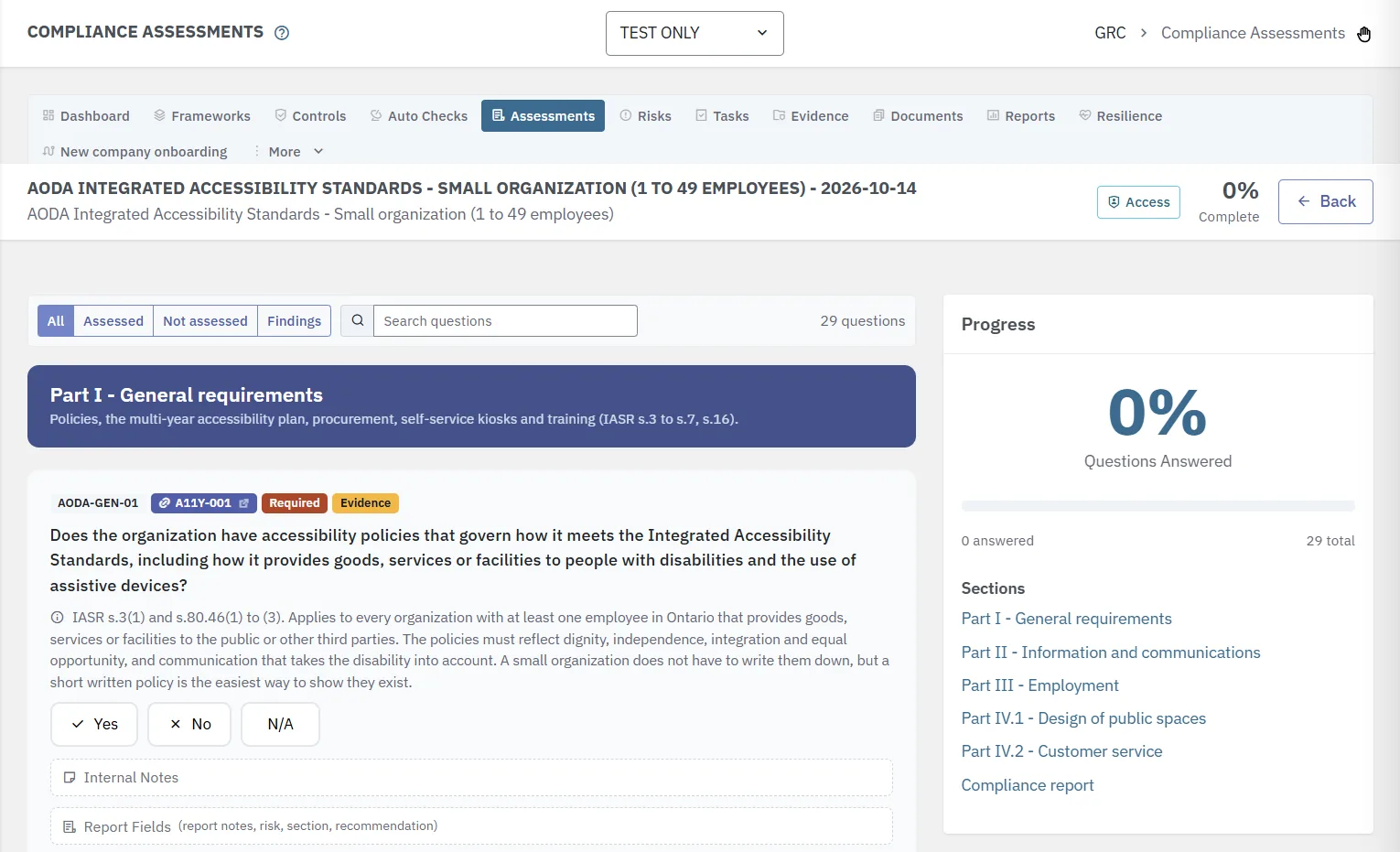
Lavawall does not file the report for you or make an organization compliant. It keeps the work and the evidence together, so the certification rests on records rather than memory. See how it works step by step.
Related
Primary sources: O. Reg. 191/11, Integrated Accessibility Standards, the Accessibility for Ontarians with Disabilities Act, 2005, and the Government of Ontario's Completing your accessibility compliance report. Last verified 14 October 2026. This page is general information, not legal advice.
Frequently asked questions
Who does the AODA apply to?
The Integrated Accessibility Standards Regulation, O. Reg. 191/11, applies to the Government of Ontario, the Legislative Assembly, every designated public sector organization, and every other person or organization that provides goods, services, or facilities to the public or other third parties and has at least one employee in Ontario. A company with its head office in another province or country is covered as soon as it has one employee in Ontario.
When is the next AODA compliance report due?
For businesses and non-profits with 20 or more employees in Ontario, the Government of Ontario gives the deadline as 31 December 2026. Organizations with 50 or more employees report on all the standards every three years; those with 20 to 49 report on the customer service standard only. Organizations with fewer than 20 employees do not file. Designated public sector organizations file every two years, and their last deadline was 31 December 2025.
Do small businesses have to make their websites accessible under the AODA?
The website requirement in section 14 of the regulation applies to large organizations (50 or more employees in Ontario) and designated public sector organizations. Since 1 January 2021 their internet websites and web content must meet WCAG 2.0 Level AA, apart from live captions and pre-recorded audio description. Small organizations are not covered by section 14, but they still have to provide accessible formats and communication supports when asked.
What are the penalties under the AODA?
Administrative penalties under the regulation reach $15,000 per contravention for a corporation, and where both the impact and the history are major, a director may treat the penalty as a daily one of up to $100,000. Prosecuted offences under the Act carry fines of up to $50,000 a day for an individual and $100,000 a day for a corporation, and directors and officers have a duty to take reasonable care to prevent the corporation from committing one.
Does Lavawall make us AODA compliant?
No tool can do that for you. Compliance belongs to your organization, and the compliance report is certified by a person with authority to bind it and filed with the Government of Ontario. Lavawall helps you track and evidence each requirement for your size, start the policies and plans the regulation asks for from templates, and prepare the report with the evidence behind every answer in one place.
Does the Lavawall AODA framework cover transportation?
No. Part IV of the regulation, Transportation, binds transit systems, school transportation, ferries, and municipalities that license taxis, and needs its own assessment. The Government of Ontario and the Legislative Assembly, which have their own schedule, are not covered either.